
If you have to chase your software company to find out what is finished, what is delayed and what happens next, you are doing work your delivery partner should own.
A well-managed software project gives you enough visibility to make decisions, enough structure to control change and a clear person to contact when something needs attention. You should be able to focus on your business while understanding exactly how the software is progressing.
That is the standard we believe a software company should meet. At Tranz Technologies, our development process connects the work from enquiry through support. Client feedback on Clutch gives you another way to judge that approach: as of 13 November 2026, our profile has a 5.0 overall rating across seven verified client reviews, with specific praise for project management.
Here is what you should expect from a software partner, and how we approach it.
Start with the business decision behind the software
Before a team estimates screens or chooses technology, it should understand what the software needs to improve.
Are staff entering the same information into several systems? Does a customer have to call your team for a status update? Is a new product waiting on a workflow that your existing application cannot support?
Those questions lead to a stronger project brief than a feature list alone. They help the team agree which users matter, which workflows need attention and what the first useful release must accomplish.
A good project manager turns that understanding into clear scope, priorities and acceptance conditions. You can then review the plan against your business goal rather than trying to interpret a list of technical tasks.
Before agreeing to a proposal, ask the team to explain your problem back to you. Their answer should sound like your business, with enough detail to show that they understand the difficult parts.
Give clients visibility without making them chase updates
A progress meeting should help you decide something. It should not be the only place where you can discover whether work has moved forward.
Tranz uses delivery tools, including our own ERP tools, to track the development process. Clients receive access, allowing them to follow progress alongside the team. We also provide a project timeline and schedule covering planned stages and milestones.
For you, the value is practical: you have a place to follow the work and a shared plan for the conversation. Feedback, open questions and changes can be discussed in context.
When evaluating a software company, ask how you will see completed work, outstanding decisions and changes to the plan. A project dashboard is useful when it helps you understand delivery, not merely when it contains a large number of tickets.
Make accountability clear across the project
When a commercial question, delivery issue and planning concern all arrive together, you should not have to work out which person can resolve each one.
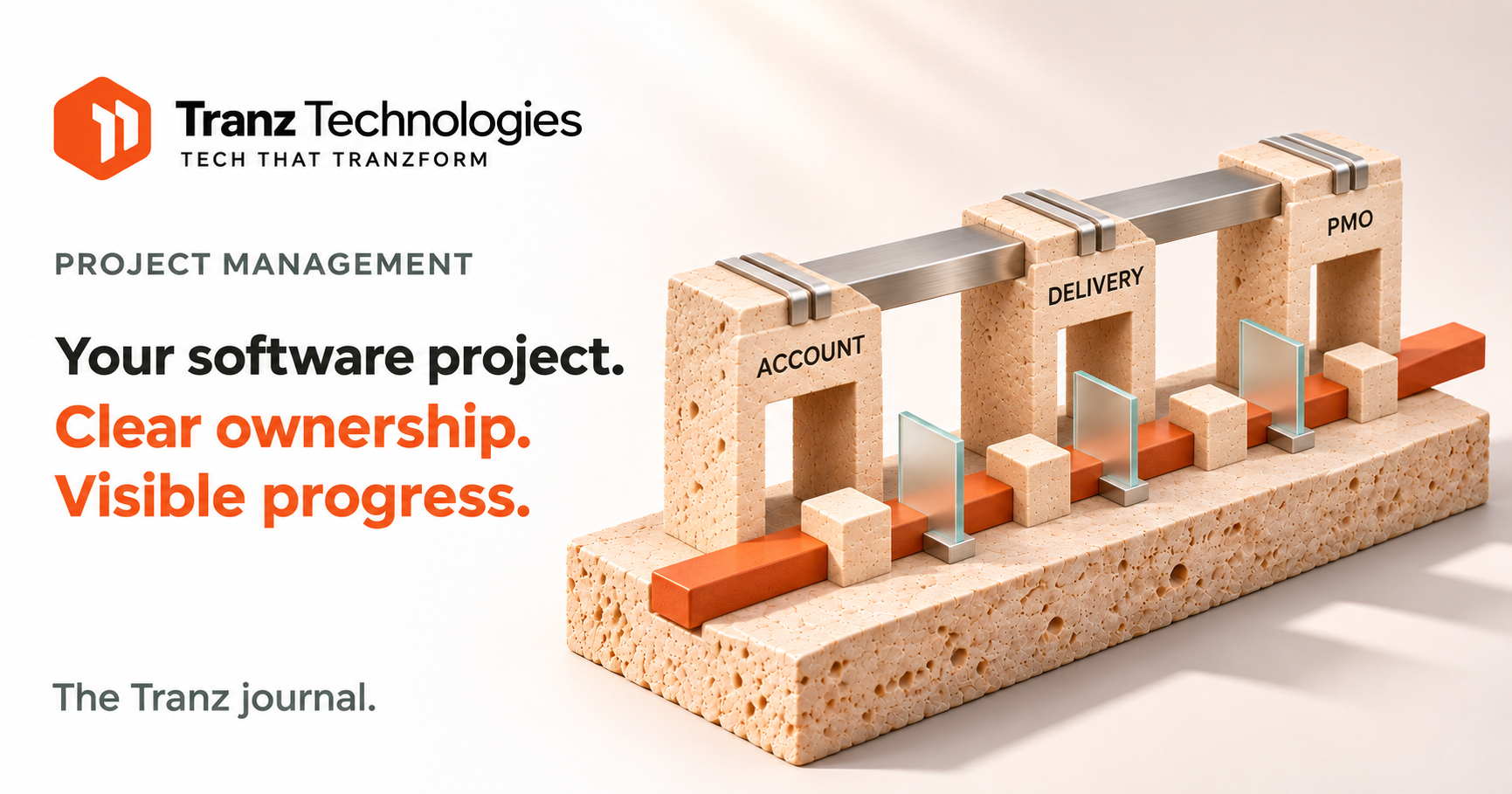
Our published process assigns three management roles:
| Role | Responsibility | What it means for you |
|---|---|---|
| Dedicated Accounts Manager | Account relationship, commercial coordination and ongoing communication | A clear contact for the relationship and commercial discussion |
| Delivery Head | Delivery execution and alignment with agreed scope and schedule | Someone accountable for coordinating the work |
| PMO Head | Planning, progress tracking, dependencies and escalations | Oversight of the decisions and dependencies affecting progress |
The purpose of these roles is clear ownership. A software company should make it easy to identify who is handling an issue, what decision is needed and when you will hear back.
Ask about escalation before you need it. Clear responsibilities are most valuable when the project encounters a difficult trade-off.
Connect the delivery stages to decisions you can review
Tranz's development process covers ten stages: Enquiry, Proposal, Project Kickoff, Requirement Analysis, Design, Engineering, Functional Requirements Testing, Non-functional Requirements Testing, Build & Release, and Support.
For a client, the value of a defined process is knowing what you are reviewing and why your input matters.
During requirements, you should be able to challenge how the team has understood your workflows. During design, you should be able to review how people will use the software. During engineering and testing, the conversation should move toward working behavior and whether it meets the agreed requirements.
We collect and review feedback throughout documentation, releases, testing and production. That creates opportunities to address misunderstandings as work progresses.
A useful question for any prospective partner is: “What will we be able to review before the next major commitment?” The answer should describe a concrete output, such as documented requirements, a design or working software.
Handle requirement changes with an explicit decision
Your understanding of a product can improve when you see it working. A responsible software company should have a way to evaluate new requirements and explain their effect.
Suppose a customer portal needs an additional approval step. The team should clarify who approves, what happens when a request is rejected and whether notifications or reports also change. It should then explain the effect on effort, sequence and the planned release.
You can make an informed choice: include the change, exchange it for a lower-priority item or place it in a later release.
This is a practical standard to request when agreeing how a project will run. Changes become easier to manage when both sides understand what is being approved and how the delivery plan will reflect it.
Make testing and release readiness part of the plan
A feature being built and a feature being ready for your users are different milestones.
Our process identifies functional and non-functional testing as separate stages. Functional testing checks the required behavior. Non-functional testing addresses agreed qualities such as performance and other operating requirements relevant to the project.
For your business, acceptance should include the workflows people need to complete, their permissions and the exceptions they must handle. A successful demonstration should help establish whether the software works for those situations.
Before release, ask who accepts the result, who supports users and how issues will be escalated. Those responsibilities deserve attention while the delivery plan is being agreed.
Read what clients say about the way we manage projects
The strongest project-management claims have evidence beyond the supplier's own website. Our Clutch reviews include feedback about how clients experienced the work.
BeeWise / Quantora Innovations: The client describes being able to track task timelines and status through ERP tools, and says:
“Their project management style is impressive.”
Read the verified BeeWise review.
Empire Roofing: The client reports on-time delivery and highlights the team's commitment:
“Their project management team and process are impressive.”
Read the verified Empire Roofing review.
Stardioz: The client reports that the team delivered on time despite changes to requirements and describes the working relationship as feeling like an internal team. Read the verified Stardioz review.
These reviews describe specific client experiences. They give you evidence to explore when deciding whether our way of working fits your project.
Agree what happens after the release
A project plan should make ongoing ownership clear before the software goes live.
Tranz offers three delivery models: Build & Transfer, Build & Maintain, and Build → Operate → Transfer. We agree the responsibilities for operations, handover and maintenance before the engagement begins.
Choose the arrangement around your team's needs. You may want to take over the software, retain a development partner for maintenance or arrange an operating period before transfer.
Ask what your team will receive, who will maintain the application and how support responsibilities change after handover. Those answers belong in the engagement discussion alongside features, cost and schedule.
Choose a partner whose process you can inspect
Before selecting a software company, ask five questions:
- Can they explain the business outcome and the first useful release?
- How will you see progress and provide feedback?
- Who owns delivery, planning and escalation?
- How will requirement changes affect the agreed plan?
- What happens after release, and what do clients say about working with them?
Tranz gives you a published process to review and independent client feedback to examine. Start with how we work, then look at the reviews linked above.
If you are planning a product, an ERP or a custom business application, talk through your project with Tranz. Share the business problem, who will use the software and the release you are working toward. We can discuss the scope, delivery approach and responsibilities your project needs.
Talk through your software challenge.
Tell us what you want to build and the business challenge behind it.
Discuss your project ↗