
No API Support
Your software was built years ago, without APIs that external AI systems can use.
Your enterprise software holds years of valuable business data. Don’t let outdated architecture or missing APIs prevent you from unlocking its potential.
We connect your existing ERP, CRM and custom enterprise applications to modern AI assistants and agents — without requiring a complete software replacement.
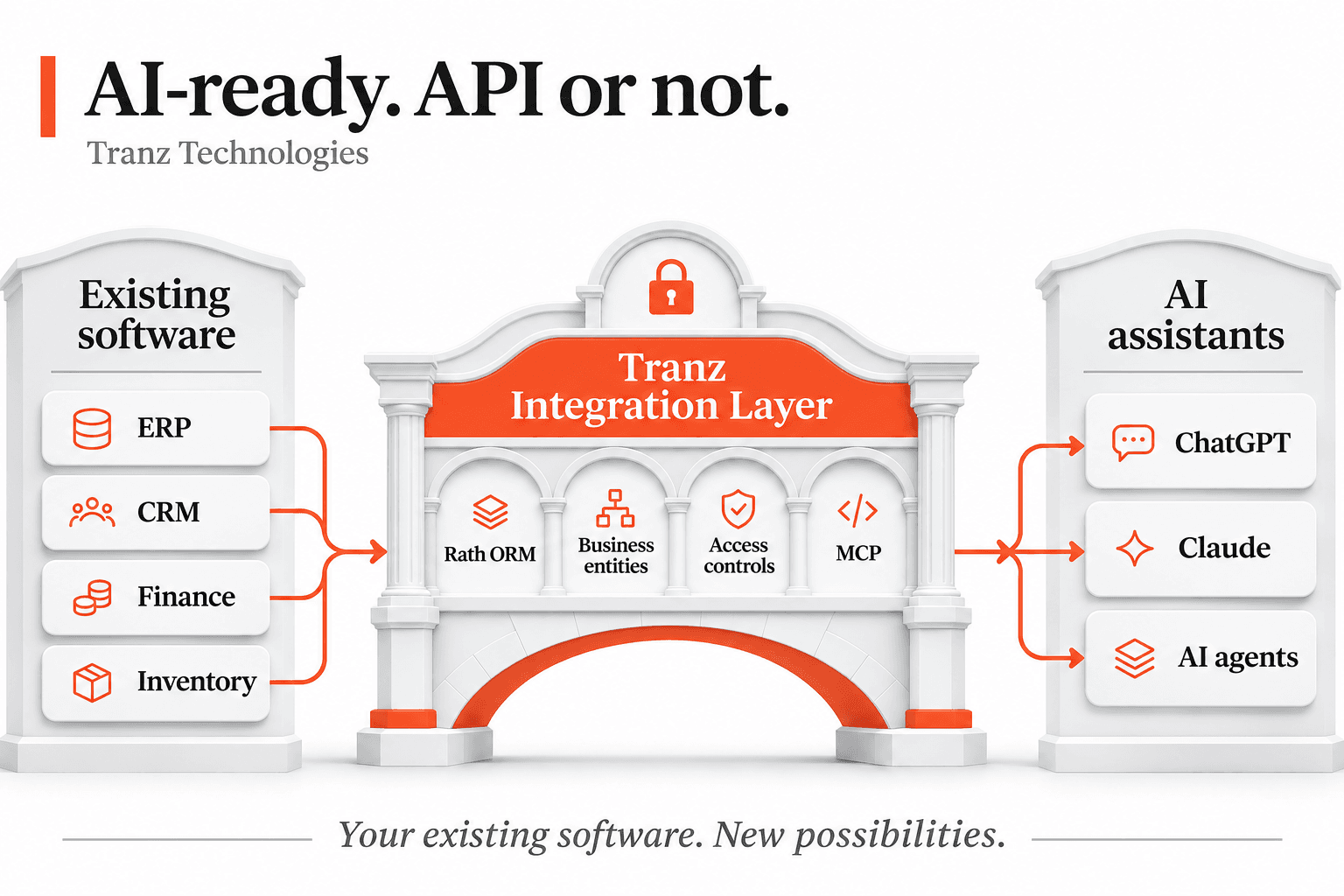
AI is changing how businesses access information, make decisions and manage operations. Many established businesses still rely on software never designed to communicate with modern AI systems.
Your software was built years ago, without APIs that external AI systems can use.
Existing APIs may serve the application interface without exposing the business capabilities your team needs.
Years of valuable information remain inaccessible to modern AI assistants.
Management relies on employees to prepare reports, analyse information and answer routine business questions.
Rebuilding an ERP or business application is expensive, time-consuming and potentially disruptive.
Generic integrations cannot automatically understand your revenue, commissions, inventory or outstanding payment calculations.
Missing APIs should not be the reason your business misses out on AI.
Your software doesn’t need to be modern to work with AI.
We build an intelligent integration layer between your existing enterprise software and modern AI assistants. Instead of depending exclusively on application APIs, our approach can use authorised database connections to understand data structures, relationships and business entities.
Supported assistants access approved information through controlled, business-specific tools. Your existing software continues serving its original purpose while AI becomes an additional way to interact with your business information.
Book an AI Integration Discovery CallAccess approved business information through natural-language conversations, instead of navigating screens, exporting spreadsheets or waiting for reports.
How is my business performing this month?
Example AI responseIllustrative month-to-date revenue is ₹42 lakh, compared with ₹38 lakh for the equivalent period last month. Revenue is up 10.5%. The West region needs review.
With authorised access, we analyse tables, columns, constraints, primary keys, foreign keys and relationships.
We work with your business and technical teams to understand terminology, workflows, calculations and business rules.
Using Rath ORM, our proprietary framework, we model meaningful entities such as customers, sales, payments, inventory, distributors and transactions.
An MCP-based layer exposes approved business capabilities to compatible assistants, within agreed security requirements and authorised operations.
We validate calculations, data accuracy, query behaviour and permissions before deployment into the agreed environment.
No existing application APIs required. No unnecessary software replacement.
Traditional integrations depend heavily on application APIs. An alternative layer can use authorised database access, structured business entities and validated business logic.
ERP · CRM · Accounting · Inventory management · Custom business applications
PostgreSQL is documented for Rath ORM. Other relational databases are subject to compatibility assessment. Authorised, least-privilege access is agreed first.
Automated schema discovery · Rath ORM model generation · Business entity definitions · Validated business rules · Controlled query execution · Access policies
Business-specific tools · Structured responses · Controlled operations · AI-compatible interfaces
ChatGPT · Claude · Compatible enterprise AI assistants · Custom AI agents, subject to supported connectivity and configuration
This gives businesses a route to AI adoption without waiting for their existing software vendor to introduce new APIs.
| Consideration | Traditional API-dependent integration | Tranz Legacy AI Integration |
|---|---|---|
| Existing API availability | Usually required. | Not necessarily required. |
| Access to historical data | Limited to available endpoints. | Based on approved database access and business entities. |
| Business understanding | Dependent on API definitions and implementation. | Explicitly modelled and validated with domain experts. |
| Existing software modifications | May require new endpoints or application changes. | Read-only integrations can often be established without application changes. |
| Software replacement | May become necessary when integration options are limited. | Existing software can be retained when technically feasible. |
| AI connectivity | Often application-specific integrations. | MCP-based integration with compatible AI assistants. |
TranzIndia operates enterprise software supporting distributor management, sales, business performance and operational reporting.
Tranz Technologies implemented an MCP server using Rath ORM on top of the existing database. The integration enables AI-assisted access to business information through approved tools, without depending on existing application APIs for the implemented reporting capabilities.
Enterprise AI integration needs a controlled approach to data access, business logic and operational security.
Controls and deployment architecture are finalised for your infrastructure, use case and compliance requirements. Data handling also depends on the selected AI provider and configuration.
Read-only access is the recommended starting point. Any future write capabilities require validated business logic, appropriate permissions and approval mechanisms.
Rath ORM is our proprietary data abstraction framework, providing a structured foundation for transforming complex database structures into meaningful, reusable business entities.
Rather than manually building an integration for every table, we use a structured foundation for understanding and accessing enterprise data.
Technical schema discovery can be automated. Business meaning, relationships in practice and calculations still require validation with your team.
Explore our Rath ORM engineering approach ↗For established businesses in manufacturing, distribution, wholesale, logistics, retail, healthcare, financial services and direct selling, including organisations running custom ERP and CRM systems.
We evaluate database compatibility, data quality, business complexity and access restrictions during discovery.
Before committing to a major AI initiative, understand whether your existing software can be connected to modern AI systems.
Start with a conversation about your existing software, your business objectives and the opportunities AI could unlock.
Book an AI Integration Discovery CallYes, provided suitable and authorised database access is available. We can establish an alternative integration layer using database structures, business entities and MCP-based tools.
Not necessarily. Our approach is designed to retain your existing software wherever technically feasible while adding AI accessibility.
Yes, subject to technical feasibility, supported MCP connectivity, account capabilities, deployment configuration and appropriate access permissions.
No. The integration should expose only approved business entities, information and operations according to the agreed access policies.
Read-only access is the recommended starting point. Write operations can be evaluated separately and require validated business rules, appropriate permissions and security controls.
Rath ORM automates technical schema discovery and model generation. Our team then identifies and validates relevant business entities, starting with the domains that offer the highest business value.
Not necessarily. Some integrations can be established using authorised database access. Certain business rules and more complex operations may require source code, documentation or support from your existing software provider.
In many read-only scenarios, yes. The feasibility depends on your database architecture, infrastructure, business logic and security requirements.
The implementation timeline depends on database complexity, business entity requirements, security requirements and the number of AI capabilities being introduced. We evaluate these factors during discovery.
Deployment options depend on the existing infrastructure, selected AI assistants and security requirements. Customer-hosted deployment can be evaluated during the assessment.
Model Context Protocol is an open standard that enables compatible AI applications to connect to external tools and data sources in a structured manner.
Yes. Tranz Technologies works with businesses internationally, subject to project requirements and applicable security and compliance considerations.
Your existing software already contains valuable business information. Let us help you unlock its AI potential.